

Used Midsize Sedan Comparison
A used Camry gets you a 52-mpg hybrid in almost every model year and, from 2020, the only all-wheel-drive car of the two; a used Accord gets you the bigger back seat and trunk and a 33-mpg turbo four. Here’s how they stack up year by year for Connecticut and Western Massachusetts buyers, written by a Toyota dealer near Hartford and Springfield that buys both cars outright.
Toyota
Used Camry
Typical used price: about $13,000–$29,500 (2016–2024, national)
2012–17 · 2018–24 · 2025+ · hybrid offered every year · AWD 2020 and newer
Honda
Used Accord
Typical used price: about $12,900–$28,800 (2016–2024, national)
2013–17 · 2018–22 · 2023+ · hybrid most years · front-wheel drive only
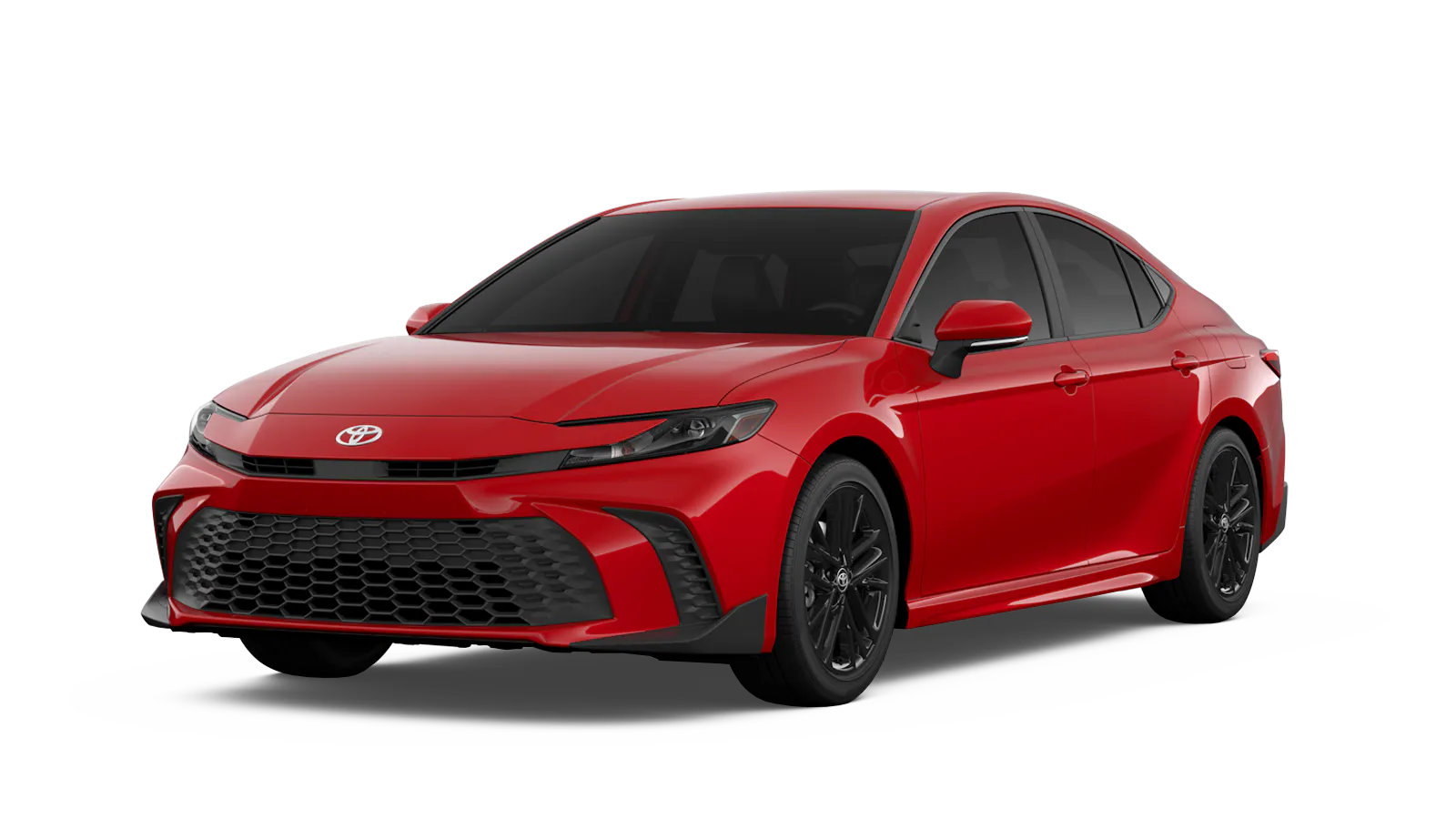
Our pick is the used Camry, and the specific car is a 2020 to 2022 Camry Hybrid LE: EPA-rated 52 mpg against 47 to 48 for the Accord Hybrid, a 10-year/150,000-mile battery warranty on every 2020-and-newer hybrid that transfers to you, and, on the gas side, the only all-wheel drive sedan of the two from 2020 to 2024. The Accord earns its wins and we list them plainly: a bigger back seat and trunk in every generation on this page, a 1.5-liter turbo rated 33 mpg, and on national averages a same-year Accord LX runs a few hundred dollars under a Camry LE. If space is the priority, buy the Accord. If you want the hybrid, the AWD or the longest coverage you can carry into a second ownership, buy the Camry. At $20,000 either one buys a 2021 or 2022 car with the full driver-assist suite and Apple CarPlay.
Kelley Blue Book’s 2026 Best Resale Value Award for midsize cars went to the Camry, and Consumer Reports ranks Toyota first for brand reliability with Honda fourth, which is the long-run case for the Camry in one line.
Where the Used Camry wins
Categories won
Where the Used Accord wins
Too close to call: Long-Term Ownership
Head-to-Head
| Specification | Used Camry | Used Accord | Winner |
|---|---|---|---|
| Generations covered | 2012–2017 (7th, refreshed 2015) · 2018–2024 (8th, refreshed 2021) · 2025 and newer (9th, hybrid only) | 2013–2017 (9th, refreshed 2016) · 2018–2022 (10th, refreshed 2021) · 2023 and newer (11th) | Tie |
| Typical price, 3-year-old (2023) | LE about $21,800 · Hybrid LE about $23,400 · XLE about $24,500 (KBB Fair Purchase Price, national, Nov 2026) | LX about $21,500 · EX about $23,000 · Hybrid EX-L about $24,700 (KBB, national, Nov 2026) | Tie |
| Typical price, 6-year-old (2020) | LE about $17,600 · Hybrid LE about $18,950 · XLE about $20,500 (KBB, Oct 2026) | LX about $17,400 · Hybrid about $18,850 · EX-L about $19,300 (KBB, Oct 2026) | Tie |
| Typical price, 10-year-old (2016) | LE about $13,350 · SE about $12,900 · Hybrid LE about $14,300 (KBB, Oct 2026) | LX about $12,900 · EX about $13,600 · Touring V6 about $14,500; no 2016 hybrid (KBB, Nov 2026) | Accord |
| Engines / transmissions by generation | 2012–17: 2.5L 178 hp or 3.5L V6 268 hp, 6-speed automatic · 2018–24: 2.5L 203 hp or 3.5L V6 301 hp, 8-speed automatic · 2025+: 2.5L hybrid, 225 hp (232 AWD) | 2013–17: 2.4L 185 hp CVT (6-speed manual available) or 3.5L V6 278 hp, 6-speed automatic · 2018–22: 1.5L turbo 192 hp CVT or 2.0L turbo 252 hp, 10-speed automatic · 2023+: 1.5L turbo 192 hp CVT or 2.0L hybrid 204 hp | Tie |
| Hybrid availability by year | Every model year 2012–2024 (200 hp, then 208 hp); every trim 2025 and newer | 2014–2015 and 2017 (196 hp); 2018–2022 (212 hp); 2023+ on Sport, EX-L, Sport-L and Touring (204 hp); no 2016 hybrid | Camry |
| Hybrid MPG by generation (EPA combined) | 41 (2012–17 Hybrid LE) · 52 LE / 46 SE, XLE, XSE (2018–24) · 51 LE / 46 others (2025+) | 47 (2014–15) · 48 (2017) · 47 (2018–19) · 48 (2020–22) · 48 EX-L / 44 Sport, Sport-L, Touring (2023+) | Camry |
| Gas MPG by generation (EPA combined, base four-cylinder) | 28 (2012–17 2.5L) · 32–34 (2018–24 2.5L FWD) · 29 (2020–24 LE/SE AWD) | About 30–31 (2013–17 2.4L CVT) · 33 (2018–22 1.5T) · 26–27 (2018–22 2.0T) · 32 (2023+ 1.5T) | Accord |
| All-wheel drive | 2020–2024 LE, SE, XLE and XSE with the 2.5L gas engine; every trim 2025 and newer | Not offered in any year or trim | Camry |
| Trunk / rear legroom (current generation) | 15.1 cu ft / 38.0 in (2025+) | 16.7 cu ft / 40.8 in (2023+); 16.7 cu ft / 40.4 in on 2018–2022 | Accord |
| Standard driver-assist by year | Toyota Safety Sense P on every trim from 2018; TSS 2.5+ 2021–2024; TSS 3.0 2025+; available pre-collision and blind-spot on 2015–17 XLE/XSE | Honda Sensing on every trim from 2018; available on every trim (standard on Touring) 2016–2017 | Tie |
| Apple CarPlay from model year | 2019, every trim (Android Auto from 2020) | 2016 on EX and above; 2018–2020 on Sport and above; every trim from 2021 | Accord |
| Hybrid battery warranty (transfers) | 10 yr / 150,000 mi on 2020 and newer, “first ownership and all subsequent owners”; 8 yr / 100,000 mi on 2019 and earlier | 8 yr / 100,000 mi high-voltage battery capacity warranty, every year | Camry |
| Powertrain warranty left on a 3-year-old | 5 yr / 60,000 mi from first sale, transfers automatically; a 2023 sold mid-2023 runs to mid-2028 or 60,000 miles | 5 yr / 60,000 mi from first sale, transfers automatically; same math on a 2023 | Tie |
| Longevity / ownership evidence | Camry Hybrid: 11.5% chance of 250,000 miles vs 5.3% average (iSeeCars, Sept 2026) · iSeeCars reliability 7.6/10, 1st of 11 midsize cars (2026) · RepairPal 4.0/5, $388 a year | Accord Hybrid: 18.5% chance of 250,000 miles, 10th of all vehicles (iSeeCars, Sept 2026) · iSeeCars 7.5/10, 3rd of 11 midsize (2026) · RepairPal 4.5/5, 1st of 24 midsize, $400 a year | Tie |
| V6 years (used only now) | 3.5L V6: 268 hp 2012–2017; 301 hp 2018–2024, plus the 2020–2024 TRD | 3.5L V6: 278 hp 2013–2017; none after | Camry |
| What $20,000 buys (national, Oct 2026) | 2021 SE (about $19,600) · 2022 LE (about $19,900) · 2020 XLE (about $20,500) · 2020 Hybrid LE (about $18,950) | 2021 Sport (about $19,800) · 2022 LX (about $20,200) · 2020 EX-L (about $19,300) · 2021 Hybrid (about $19,600) | Tie |
| Resale Value (KBB 2026 Best Resale Value Awards) | Best Resale Value: Midsize Car; Toyota is the 2026 brand winner (about 53% of sticker kept at 5 years) | No 2026 award | Camry |
| Brand Reliability (Consumer Reports, Dec 2025) | Toyota 1st, score 66 | Honda 4th, score 59 | Camry |
| Hybrid Track Record | Camry Hybrid every model year since 2007; Toyota hybrids since 1997, about 30 million sold worldwide through 2025 | Accord Hybrid 2005–07, 2014–15 and 2017–present; Honda’s two-motor system since 2014 | Camry |
Used prices are Kelley Blue Book Fair Purchase Price national averages for the trims named, checked in October and November 2026; they move weekly and are not Gale prices. Specifications and fuel economy are manufacturer and EPA figures for the model years shown and vary by trim and configuration. Competitor figures are shown for comparison and are subject to change; confirm details with the manufacturer. Current Gale used pricing is on each vehicle page, written out the door with the $649 documentation fee included.
Category by Category
Winner: Accord
On KBB’s national averages the Accord runs a few hundred dollars under the Camry at the same age: a 2023 Accord LX is about $21,500 against $21,800 for a 2023 Camry LE, a 2020 LX about $17,400 against $17,600, and a 2016 LX about $12,900 against $13,350. Hybrids are within $100 at six years old. CarGurus reported in mid-2026 that used Camry prices had risen about 6 percent over the prior year and used Accord prices under 1 percent, which is why the Accord is the better deal today.
Winner: Camry
The Camry Hybrid has been sold every model year since 2007, so there is one at every age and budget; the Accord Hybrid was not sold for 2016 and, in the current car, comes only on the upper trims. The 2018–2024 Camry Hybrid LE is rated 52 mpg combined against 47–48 for the same-year Accord Hybrid, about $85 a year at 15,000 miles and $3.50 a gallon. On gas engines the order flips: the Accord’s 1.5-liter turbo is rated 33 mpg to the Camry 2.5-liter’s 32–34.
Winner: Accord
This is the Accord’s clearest win, and it holds in every generation here. The 2023-and-newer Accord has 40.8 inches of rear legroom and a 16.7-cubic-foot trunk against 38.0 inches and 15.1 cubic feet in the 2025-and-newer Camry; the 2018–2022 Accord already had 40.4 inches and the same trunk. Both seat five and fold the rear seat, and both hybrids keep the battery under the rear seat. If you carry adults in back or a stroller and hockey bags, the Accord is the roomier car at any price.
Winner: Camry
No Accord in any of these years has all-wheel drive. The Camry offered it on the 2020–2024 LE, SE, XLE and XSE with the 2.5-liter gas engine, a mechanical system that sends up to half the torque rearward from a stop or on slip and is rated 29 mpg, and the 2025-and-newer Camry Hybrid has AWD on every trim at about 44 mpg. On winter tires either sedan handles a plowed I-91 commute; for a hill in Somers or an unplowed street in Longmeadow, look for the AWD Camry.
Winner: Camry
Both brands transfer their 3-year/36,000-mile basic and 5-year/60,000-mile powertrain coverage to the next owner automatically. The gap is the hybrid battery: Toyota covers it for 10 years or 150,000 miles on 2020-and-newer cars, written to include “all subsequent owners,” against Honda’s 8 years or 100,000 miles. Every used car under 10 years old sold by a Connecticut dealer also carries the state’s 60-day/3,000-mile warranty under Public Act 26-100. ToyotaCare runs from the original delivery, so on a used Camry don’t count on it.
Winner: Too Close to Call
The positive evidence splits. In the iSeeCars study reported in September 2026, the Accord Hybrid had an 18.5 percent chance of reaching 250,000 miles, tenth of every vehicle sold, and the Camry Hybrid 11.5 percent, both against a 5.3 percent average. RepairPal ranks the Accord first of 24 midsize cars at $400 a year and the Camry third at $388; iSeeCars’ 2026 reliability ranking puts the Camry first of 11 midsize cars and the Accord third. Buy either on records and an inspection, not on reputation.
Winner: Camry
The Camry has the resale award: Kelley Blue Book’s 2026 Best Resale Value Awards (March 2026) named it the midsize car expected to retain the most value after five years and named Toyota the Best Resale Value Brand at about 53 percent of sticker retained, against an industry average near 45; the Accord took no award. Consumer Reports’ survey published in December 2025 ranks Toyota first for brand reliability with a score of 66 and Honda fourth at 59, and notes that conventional hybrids keep scoring well. The hybrid track record also favors the Camry: a Camry Hybrid has been sold every model year since 2007 on a system Toyota has built since the 1997 Prius, about 30 million units worldwide through 2025; the Accord Hybrid has come and gone, with no 2016 model and a 2018 redesign on the two-motor system Honda introduced in 2014. The Accord’s answer is in Long-Term Ownership above, where the Accord Hybrid leads on the 250,000-mile odds.
Common Questions
The positive evidence is close enough that we would not choose between them on reliability alone. In the iSeeCars longest-lasting-vehicles study reported in September 2026, the Accord Hybrid had an 18.5 percent chance of reaching 250,000 miles and the Camry Hybrid 11.5 percent, both well above the 5.3 percent average for all vehicles. RepairPal rates the Accord 4.5 out of 5 (first of 24 midsize cars, about $400 a year in repairs) and the Camry 4.0 (third, about $388), while iSeeCars’ 2026 reliability ranking puts the Camry first of 11 midsize cars and the Accord third. Each generation here ran five to seven years on the same powertrains, so parts and know-how are everywhere, and both brands transfer their 5-year/60,000-mile powertrain warranty to the next owner. Buy whichever one has the records and passes an inspection. Open recalls on any VIN are listed at toyota.com/recall; ask us and we will confirm anything open was completed before the car reaches the front line. For an Accord, Honda’s own VIN lookup is at owners.honda.com.
The Accord, by a few hundred dollars at the same age on Kelley Blue Book’s national Fair Purchase Price (checked October and November 2026). A 2023 Accord LX is about $21,500 against about $21,800 for a 2023 Camry LE; a 2020 Accord LX about $17,400 against $17,600 for a 2020 Camry LE; a 2016 Accord LX about $12,900 against $13,350 for a 2016 Camry LE. Hybrids are within about $100 at six years old (2020 Accord Hybrid about $18,850, Camry Hybrid LE $18,950). Those are national retail averages; current Gale used pricing is on each vehicle page, written out the door with the $649 documentation fee included.
For the Camry, a 2021 or 2022 LE, SE or Hybrid LE: the refreshed 2018–2024 generation with Toyota Safety Sense 2.5+, the 7- or 9-inch screen with Apple CarPlay and Android Auto, 52 mpg on the Hybrid LE, the 10-year/150,000-mile battery warranty, available AWD on the gas car, and about $18,750 to $22,100 on national averages. For the Accord, a 2021 or 2022 LX, Sport or Hybrid: the refreshed 2018–2022 generation, which put the 8-inch touchscreen with CarPlay and Honda Sensing on every trim, rates the 1.5-liter turbo at 33 mpg and the hybrid at 48, and runs about $18,100 to $23,300. CarGurus’ June 2026 Accord guide describes that generation as the one offering great value. On a tighter budget, a 2016–2017 Accord EX or a 2015–2017 Camry LE gets you the refreshed version of the older generation for about $12,000 to $14,500.
It depends on the engine. Hybrid for hybrid, the Camry wins: the 2018–2024 Camry Hybrid LE is EPA-rated 52 mpg combined and the 2025-and-newer LE 51, against 47 for the 2018–2019 Accord Hybrid, 48 for 2020–2022 and 48 for the 2023-and-newer EX-L Hybrid (44 on Sport and Touring). Gas for gas, the Accord wins: the 2018–2022 1.5-liter turbo is rated 33 mpg combined and the 2023-and-newer 32, against 32 to 34 for the 2018–2024 Camry 2.5-liter and 29 for the AWD version; the 2013–2017 Accord 2.4 is rated about 30–31 to the 2012–2017 Camry 2.5’s 28. At 15,000 miles a year and $3.50 a gallon, a 52-mpg Camry Hybrid uses about $1,010 in fuel, a 48-mpg Accord Hybrid about $1,095, and either 32–33-mpg gas car about $1,600.
On the Camry, yes, and Toyota says so in writing: for the 2020 model year and later the hybrid battery is covered for 10 years or 150,000 miles from first sale “for first ownership and all subsequent owners”; 2019 and earlier Camry Hybrids carry 8 years or 100,000 miles, which has now expired on 2017 and older cars. Honda covers the Accord Hybrid’s high-voltage battery for 8 years or 100,000 miles against greater-than-normal capacity loss, and its basic and powertrain warranties transfer automatically to later owners; confirm the battery term on the specific VIN with a Honda dealer. Either way, ask for a dealer hybrid battery health report before you buy, and remember that Connecticut’s 60-day/3,000-mile dealer warranty applies to any used car under 10 years old sold here, including to Massachusetts buyers who purchase in Connecticut.
The Camry, if you buy one with all-wheel drive, because no Accord of any year offers it. AWD was available on the 2020–2024 Camry LE, SE, XLE and XSE with the 2.5-liter gas engine (never with the V6 or the hybrid in that generation) and is offered on every 2025-and-newer Camry Hybrid trim. A front-wheel-drive Camry and a front-wheel-drive Accord are evenly matched on a plowed road; on either, a set of winter tires does more than the drivetrain. Think twice about a front-drive V6 of either brand or a car on 19-inch summer-biased tires if your commute includes an unplowed hill in Somers or Suffield.
The Accord, in every generation on this page. The 2023-and-newer Accord has 40.8 inches of rear legroom and a 16.7-cubic-foot trunk; the 2025-and-newer Camry has 38.0 inches and 15.1 cubic feet. The 2018–2022 Accord already had 40.4 inches of rear legroom and the same 16.7-cubic-foot trunk. Both seat five, both have a folding rear seat, and both hybrids keep the battery under the rear seat rather than in the trunk on the 2018-and-newer cars, so the hybrid costs you no cargo space on either.
At Gale Toyota in Enfield, which buys both outright whether or not you buy a car from us. Trade or sell on our sell or trade page if you are also shopping, which in Connecticut takes the trade value off the taxable price of what you buy, or sell outright to The Buy Center of Enfield, our car-buying operation, which buys Toyotas, Hondas and other makes. Bring the title or your lender’s payoff information, the registration, a photo ID for every owner on the title, all the keys and whatever service records you have; the appraisal is free and the offer is in writing. We serve Hartford, Springfield, Agawam, Somers, Suffield, Windsor Locks and Longmeadow.
The Camry, on the latest projection. Kelley Blue Book’s 2026 Best Resale Value Awards (March 2026) named the Camry the midsize car expected to retain the most value after five years and Toyota the Best Resale Value Brand, at about 53 percent of sticker against an industry average near 45 percent. The Accord has historically resold well too, and on a used car the spread is small; mileage, records and condition move an individual car’s value more than the badge does.
Why Buy Here
Family-owned in Enfield, CT since 1969. Three generations. One promise: We’ve Got You.
01
When we install a part — brakes, battery, alternator, or more — we back it with a lifetime warranty on that part and the labor to reinstall it. You pay once. That’s it.
02
Three generations of the same family at 50 Palomba Drive in Enfield. We’re your neighbors — and we’ll still be here to service what we sell you.
03
Right on the Massachusetts border — convenient for buyers from Springfield, Agawam, Longmeadow, and all of northern Connecticut. Most customers are within 30 minutes.
We put every used car through the shop before it reaches the front line and do the work needed. Drive a used Camry Hybrid and an AWD Camry back to back in Enfield, minutes from Springfield, MA and Hartford, CT, and bring your Accord if you have one to sell.
